
Private Mailbox DTSPB23
Adenta, Accra
GPS Location: E3-331-3736
Peduase Road,Ghana
WELCOME TO TRAVEL GHANA
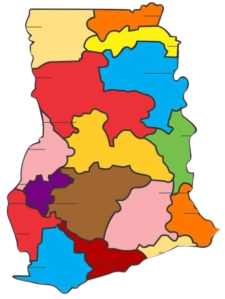
Famous for gold and cocoa production, The Ashanti region is located in the southern part of Ghana and its largest city is Kumasi also known as The Garden City.
Distance:
Road: 198.55 km 4hrs 45 minutes
Flight: 251 km 44min
Built in 1925 by the British, The Palace is one of the unique places dear to the hearts of the Asantes; Housing great exhibits and historical objects of the Ashanti Kingdom. The Palace also houses the famous Golden Stool also known as the Asikadwa Kofi which is believed to hold the spirit of Asante nation.
There have been several unsuccessful attempts to remove this sword. It is said to be a symbol of unity and strength amongst the Asantes. Planted by the first high priest of the Ashanti Kingdom, Okomfo Anokye, this sacred Sword Site can be found at the komfo Anokye Teaching Hospital.
Bonwire is a town located 18km on the Kumasi-Mampong Road, it is the leading center for the weaving of Iconic Kente cloth in the Ashanti Region. The art of weaving the Kente Cloth is said to have been developed by observing a spider spinning its web.
Renowned for its elite higher education institutions, the central region is one of the major centers of tourism with emphasis on Slave trade, Colonial Rule
Distance:
Road: 125.84 km 2 hrs. 50minutes
Today it is recognized by UNESCO as a world heritage site. The Elmina Castle is the oldest European building in existence below the Sahara. It was first established as a trade settlement, and it later became one of the prominent stops on the route of atlantic slave trade.
Originally the center of trade of timber and gold, the cape Coast castle later became a domicile of Trans-atlantic slave trade. In the Cape Coast Castle, there is a dungeon where the slaves were kept, holding deep memories and marks of death, fear, panic. Also in the Cape Coast Castle, you get the opportunity to see the GATE of No Return.
The Kakum National Park is one of the most visited attractions in Ghana, The area covered with tropical forest was established by the initiative of the local People. The park has about 7 hanging bridges secured by nets for safety which allows visitors to walk through the canopy walk.
Rich in culture and diversity of language, the region is multi-ethnic [5] and multilingual, including groups such as the Ewe, the Guan, and the Akan people. The region stretches from the coastal plains on the Atlantic coast right up to the arid lands of the north, and climatic conditions can vary tremendously.
Distance:
Road: 138.85 km
Interestingly, Afadjato has been wrongly referred to as “Mountain Afadjato”, where
Afadja is the name of the mountain and the suffix “to” in ewe means Mountain. So
either Mount Afadja or Afadjato. Afadjato is the tallest mountain in Ghana and an
exciting place for hiking and a new feel of experience in Ghana.
Surprisingly, the Umbrella rock is one of the most visited attractions in Ghana. Historically discovered by a hunter, the rock can shelter about 12-20 people. This rock has been standing for decades now and due to its aesthetic nature, the shape and name derived.
The Boti Falls located in the Yilo located in the Yilo Krobo district. The fallsare two, a lower and an upper one believed to be a female and a Male respectively. The Waterfalls is said to have been discovered by a white Catholic Priest.
The Northern Region is a Guinea Savanna grassland. The temperatures can vary between 14 °C (59 °F) at night and 40 °C (104 °F) during the day. The region is also home to fugu textiles, with production centers in Tamale, Gushegu, and Yendi.
Distance:
Road: 432.72 km
The Palace is popular because it is the seat of the Yaa Naa of the Kingdom of the Dagbon. Yaa Naa in Dagbon means King. It is in Nayilifong along the Yendy Saboba Road in Yendi.The Naa Gbewaa palace was named after Darimani who was only king for seven weeks.
Said to have lived for over 330 years. The tree was named after a great king in Dagbon, Naa Binbegu. It served as a place where Binbegu used to mount his gods and idols. It is said to possess enormous powers.
Mole National is listed as one of the largest and richest parks in Ghana and a home to many plant and animal species. Uniquely as the most elephant populated parks in Ghana. The Park’s mission is to sustainably manage the wildlife resources of the Park, Increase revenue, and generate economic activities around the park with a view to contribute towards local Socio-economic development.
The Greater Accra region is the most urbanized region in the country, It's capital is Accra also the capital of the country Ghana. It is the second largest region in the country.
Distance:
Road: 5.8 km
The Kwame Nkrumah Memorial Park and Mausoleum, dedicated to the nation’s first prime minister, a famous Pan-Africanist, has everything you need to know about the former prime minister and his contributions to the nation Ghana.
Also known as the Independence square, it is known to be the second largest city square in the world and possibly the largest in Africa. It was commissioned in 1961 and held up as a sign of Independence of the nation Ghana in 1957 when its construction was commissioned by Dr. Kwame Nkrumah.
So many activities can be done at the Botanical Gardens such as, Picnics, Canopy walks, Rope course and many others. It has successfully served its purpose and is still serving, its purpose being recreation. This beautiful garden is located in the University of Ghana campus, Legon.
Newly created region under the governance of the New Patriotic Party, The Ahafo region was birthed out of the Brong Ahafo Region. The region has lots of forest reserves and well known forits timber industry.
Distance:
Road: 288.19 km
The white necked fowl is considered Africa’s most desirable bird and a symbol of ecotourism. Until 2003 at Asumura, there had been no reports of the bird. Now the Asumura town is the home to this bird.
Stories about the Mim Buor tells that, in the past, the paramount Chief of Mim used to climb the
mountain (“Mim Bour”) to address his subjects. It was added that when he climbed, he was able
to see all the areas under his jurisdiction and even as far as Techiman and Kumasi.
● OLA Girls Senior High, Kenyasi
● Nkoranza Technical Institute
The Oti region was created from the Volta Region and the Northern Region. The vegetation consists predominantly of grassland, especially savanna with clusters of drought-resistant trees such as baobabs or acacias. There are quite remarkable places to visit in the Oti Region.
Distance:
Road: 282.01 km
Established in 1993, Inside the park is the 2nd largest mountain in Ghana, Mount Dzebobo. This park is not very famous as compared to the other parks but it has very beautiful scenery and a peaceful forest reserve.
The breast mountain can be found in the Kyabobo National Park. It is called the breast mountain because it has the shape of the Female Breast.
The hanging village also known as “Shiare” has surprisingly gained popularity over the past few years. Shiare is an enclosed village located north of Oti region. There are no roads to Shiare excepts for a rocky path.
As its name suggests, Savannah, the region is primarily Grassy. It was birthed out of the Northern Region and one of the largest new regions to be created.
Distance:
Road: 429.24 km
The Larabanga mosque is the oldest mosque in Ghana and in west Africa. Also Known as Mecca of the West, it is believed that a man named Ayuba, an islamic trader built started construction of the Mosque. Its foundation is said to have been mysteriuosly laid. Non-Moslems are not allowed into the mosque.
Daboya the most famous of Ghana’s fugu weaving communities from which popular smocks and other clothing are made for both daily life and ceremonial occasions.
● Damongo Senior High
● Buipe Senior High
● Bole Senior High
Popularly known as the Oil City, The Western Region with its Capital Takoradi is one of the most beautiful places to visit in Ghana. It includes Ghana's southernmost location, Cape Three Points, where crude oil was discovered in commercial quantities.
Distance:
Road: 185.94km
Meaning "water surface" With over 500 settlements, The Nzulezo Village is located near the village of Beyin, 90 kilometers west of Takoradi. It is about 400 years old. The village is popular because the houses in the village are built on stilts, "The town on water"
Wondering why the name Cape 3 points? The name came about from a convergence of 3 separate capes.The village of Cape Three Points is the southernmost community in Ghana, and its beach is one of the most beautiful along Ghana’s West Coast. Surrounded by Ghana’s only coastal rainforest reserve and many rolling hills, the village also has a few secondary attractions, such as relaxation, beach and sea activities, hiking, and exploration of its cultural present and colonial past.
With relatively minimal popularity, The Ankasa game reserve has uniquely maintained an evergreen wet forest due to its location in the area with the highest rainfall. The forest has the most biological diversity of any in Ghana, with over 800 vascular plant species, 639 butterfly species, and more than 190 bird species. Animal life includes the elephant, bongo, leopard, chimpanzee, Diana monkey, and other primates.
Due to its proximity to Sahara and Sahel, the Northeast Region is much drier. The Northeast Region was carved out of the Northern Region. The aboya fugu weaving is one of the main attractions.
Distance:
Road: 551.97 km
At this point just north of Gambaga, the massive White Volta River is funneled through a rocky
outcropping where its roar can be heard far away. The White Volta River is the primary source of
Lake Volta, Ghana’s massive man-made lake in the south of the country. It is joined by the Red
Volta River in the Northeast Region near Bongbini and later by the Black Volta River in the
Savannah Region.
The Gambaga Scarp is a line of cliffs that run along the northern border of Ghana’s Northeast Region. They are composed of horizontal layers of sandstone and rising over 300 meters high in
some places. All along the escarpment there are many opportunities for hiking and bouldering.
The Bono East is a new region, Formed from the Brong Ahafo region. The region are produced of most agricultural produce (food). They also engage a lot in fishing activities. There are exciting places to visit in this region.
Distance:
Road: 293.90 km
Kintampo waterfalls is one of Ghana' highest waterfalls located in Bono East. It was formerly known as Sanders Falls during the colonial days. It is located on the Pumpum river, a tributary of
the Black Volta, about 4 kilometres (2.5 mi) north of the Kintampo municipality, on the Kumasi–Tamale road.
Boabeng Fiema monkey sanctuary is one of the renowned tourist site located in the Nkoranza North District of Bono East Region. The sanctuary has a well-furnished Guest House for the comfort of our guest. Boabeng Fiema monkey sanctuary is the famous example of traditional conservation of Forest with wide varieties of tree species engulf with birds and other animals, this is the place where two different species of monkeys, regarded as sacred happily live, eat and share their peace of minds with human beings.
The region was formed from the then Upper region. The Upper West was created by the then Head of State, Flight-Lieutenant Jerry Rawlings in 1983. It is one of the smallest regions in Ghana yet with many attractions worth a visit.
Distance:
Road: 598.40 km
The Wechiau Community Hippo Sanctuary (WCHS) is a unique community-based project, protecting and preserving the wildlife and the environment of a 40km stretch of the Black Volta River in Ghana's Upper West Region. The river is home to one of the two remaining hippopotamus populations in Ghana, and was created into a Sanctuary by local chiefs in 1999. Since then, the project has had marked success in providing Ghanian and International tourists with a unique and unusual eco-travel experience.
The lesser-known Gbele Game Reserve and bird sanctuary, 17 km south of Tumu, is an important sanctuary for endangered species of wildlife within Ghana. The reserve is also home to buffalo, hippo, elephant, buck and the country’s largest herds of roan antelope, although many species are rarely seen. Birdwatchers consider this an important habitat for indigenous and migratory species of birds.
Wa Naa's Palace is the home to the King of the Wala people who are said to be the majority in
Wa in the Upper West Region of Ghana. It is located in the heart of the town and the home to
the entire family, palace staff and officials of the kingdom. It is the place for cultural,
political, religious, and social importance for the local people. In the palace, the chief sits on
either a skin of a lion or antelope whereas others sit on the skin of a cow or sheep.
The Upper East Region is a unique tourist destination, offering visitors an amazing view of
Ghana. It is a gateway from Burkina Faso and Togo from Ghana.
Distance:
Road: 584.47 km
The pond is in Paga in the Upper East Region of Ghana which is inhabited by West African crocodiles. Due to the friendliness of the reptiles, it has become popular among tourists and the pond is now reliant on tourism to ensure the population of crocodiles remain fed and healthy. It is also known as Chief's pond.
Although a new region, which was birthed from the western region, there are exciting places to visit in this region. The Rivers Ankobra and Bia can be found in the Western North Region.
Distance:
Road: 260.01km 4hrs 45mins
Flight: 188km 40mins
The Bia National Park was named after Bia River, it was craeted in 1935 and has
been a home to over 60 species of animals, birds, and Lizards. Ghana's major
protected forest antelope communities also live in the. The forest elephant and the
bongo which is claimed to be highly threatened can be found there.
Some Famous Schools:
● Sefwi-Wiawso Senior High

